
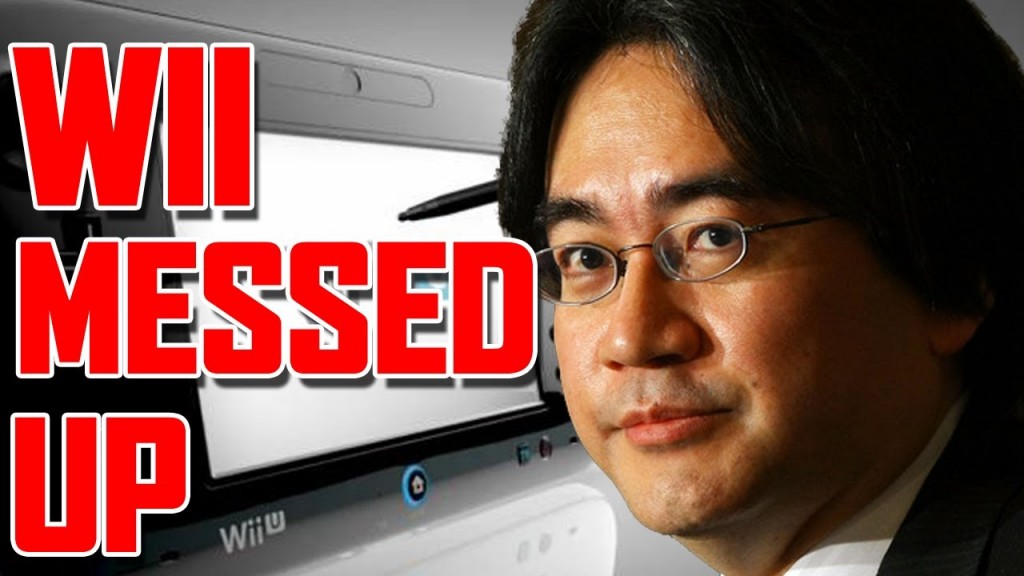
Forewarning: this is a very long post about video games. Specifically, this is a post regarding Nintendo’s recent flops with the WiiU, and taking a look at what makes this console different from the successes of the Wii. Now, with that out of the way…
I think it’s safe to say that everyone agrees that the WiiU has been a pretty epic failure for Nintendo these past few years. It is interesting to see this, however, considering that not too long ago Nintendo was dominating Microsoft and Sony in the sales figures with their Nintendo DS and Wii systems. What is the reason for this major flop for Nintendo? Are people just uninterested in Mario and company, or is there something else causing people to move away from the family-friendly gaming company? This entry will look into why the WiiU has been a complete failure compared to its predecessor, and will look at the reasons why the console has not succeeded as well as why its predecessor did so well when it did.
Turn the clock back ten years, to the fall of 2004. At this point-in-time, Nintendo was facing another economic crisis not unlike the one it faces today. The Gamecube, despite the many wonderful games being produced for it, was simply not competing well against the Xbox and Playstation 2. The reason? The Gamecube was simply outmatched by the superior hardware supplied by the Xbox and PS2; they had better processing power, better graphics, and more mature games for a more “hardcore-gamer” audience. At this point in time, gaming was still mostly a “gamer” thing; you didn’t have too many mothers or grandparents playing Mario Kart quite yet.
Then Nintendo released something revolutionary: the Nintendo DS. And very quickly, Nintendo exploded back into the top of the charts of sales. What was so great about the DS that caused this?
To begin with, it was the novelty of the device. Touchscreens were still not as common then as they are today, so the fact that you could actually use the touchscreen to play a game was really neat and fun. Added to that was the fact that you actually had 2 screens – not just one, but two – to play on, and the system seemed almost comically ridiculous, and captured a lot of people’s attention.
Additionally, the Nintendo DS had a slew of good launch titles prepped for its release, all willing to take advantage of this new hardware. The biggest of these was the remake of Super Mario 64, not only showcasing utilizing the 2 screens to add depth to an old game, but also the fact that you could now play 3D games on a portable device, something the Gameboys could not quite handle. Then, of course, there came some other novelty games that helped to push the DS towards not just gamers, but families: games like Nintendogs (in which you took care of an adorable digital pup) and Brain Age (that gave you a test to determine how “old” your brain was) helped the DS move into the casual area of gameplay, something that the other consoles at this point had not really done. Though the PlayStation Portable came out around the same time, it was never really able to compete against the DS in the handheld market.
So now we see that, by taking a bit of a risk and trying something new, Nintendo was able to push themselves back into the gaming industry. The Nintendo DS had features unlike anything else on the market, and they were usable in a manner that allowed for a lot of fun and inventive games, not only for the hardcore gamers but also for more casual players like parents. However, the Gamecube was still proving to be an utter disaster, as the incoming Playstation 3 and Xbox 360 dominated the major console landscape. Then, in 2008….
…came the Wii. Initially, when Nintendo announced it, pretty much everybody and their uncle automatically made fun of its name. It just sounded goofy, when all of the previous game systems sounded pretty standard: Gamecube, Gameboy, Xbox, Playstation, Sega Genesis. The Wii stood out, and initially it was not in a good way…then the system actually came out.
Again, Nintendo chose to take a risk and try something that had not been done before (or, at least, had not been successfully done before). It chose to use motion controls to play games, though of course also allowing you to simply use the standard controls. They gave the controller a catchy name – the “Wiimote” – and its attachment something almost equally as cool – the “Nunchuck.” Even though the processing power and graphics were still significantly behind that of the Xbox 360 and PS3, the motion controls on the Wii set it apart. And that innovation, combined with a marketing campaign that won Nintendo an Effie Award, launched Nintendo back into the spotlight of the gaming world.
But as we’ve seen before, the hardware alone cannot be enough to make a console successful. And, like the DS, the Wii had a wide array of games to choose from at launch, all of them helping to showcase just what the Wii was capable of. From “The Legend of Zelda: Twilight Princess,” one of the most highly acclaimed games of 2006 and of the entire Legend of Zelda series, to Call of Duty, the Wii showed that the motion controls could be implemented with games from pre-existing series. And, of course, all consoles in the United States came bundled with “Wii Sports,” a game which is still considered to be the most played game on the console. Suddenly, not only had handhelds become family-friendly, but so had consoles. From retirement homes to family living rooms, the Wii was the most sold console for several years in a row, dominating the sales charts and forcing Microsoft and Sony to develop their own form of motion controls.
So let’s do a quick review, before we move on to the WiiU. Both the DS and the Wii revolutionized gaming through the touch screen and motion controls. They had a plethora games available from the start – and even more so within the first year – and marketed themselves to both hardcore and casual players. As a result, they dominated the sales charts and forced their competitors to come up with ways to remain competitive.
But in 2012, things changed. When Nintendo initially announced the WiiU, it was met with much of the same scoffing and criticism that its predecessors had, including many jokes about its now-unimaginative name. However, the implementation of the game pad simply did not intrigue critics this time around as the motion controls had with the Wii. To pretty much everyone, the WiiU seemed mostly just like a hardware upgrade – with far better processing and graphics – with a very lame attempt at claiming innovation. The marketing was next to none, and even now, two years after launch, there are very few good games that actually take advantage of the new hardware. Simply put, the WiiU was not actually as innovative as the Wii and DS before it, and as a result it has proven to be an utter catastrophe for Nintendo.
There are, of course, other things to consider. The recent resurgence to PC-gaming (due mostly to the plethora of games available on Steam, and PC-gaming holding most of the competitive market) and app-gaming (such as on iPhones and whatnot) have created a large shift in the gaming industry that has caused even the XBone and PS4 to not do as well as Microsoft and Sony would have liked. But, in the end, Nintendo could have done a lot better. Rather than try to push new hardware that added very little to the original Wii, they could have simply followed in Microsoft and Sony’s footsteps and focused on a performance and graphics upgrade to be able to compete on that level. They could have marketed themselves better. And they could have waited until they had a good lineup of games to help their console sell. But they did not, and as a result Nintendo is facing a major financial crisis. They seemingly put very little of the heart and effort we saw with the Wii into the WiiU. It seems almost like Nintendo had already given up on their console before it was even released.
When it comes to video games, innovation sells. Whether that is implementing a touch screen or motion controls, innovation helps to breathe fresh new life into the gaming industry. Nintendo failed to accomplish that with the WiiU, instead trying to hide hardware upgrades behind the almost-laughable handheld controller. The 3DS, so far, still seems to be holding steady (and was the most-sold gaming console of 2013). But if Nintendo is going to get out of this slump, they’ll have to kick things into high gear.
 Jacob Ryckman