

Introduction
So the Pokémon series has gotten stale. And by stale I mean it closely resembles that piece of bread that fell under your fridge 25 years ago and you just never bothered because you didn’t think it was that big of a deal but oh god now there’s an entire colony of mold living on it and it smells awful but there’s really nothing you can do because it’s cemented itself to the floor and you’re just going to have to live with it from now on.
Okay, hyperbole aside, the Pokémon series really has remained almost unchanged since its inception. Every core game follows the same basic formula:
- You start out in some quaint little town that is also home to a Pokémon Professor.
- Said Professor gives you the choice of selecting one of 3 starter Pokémon, choosing from either the Grass, Water, or Fire types
- You follow a linear path, along which you battle trainers, collect Gym badges, and eventually fight the Elite Four or Pokémon League to prove yourself the very best
There are some variations on this – newer games tend to incorporate a “main” story involving the box-art legendary Pokémon – but for the most part they are all copy-paste the same ideas. This isn’t entirely awful – a lot of video games rely on similar tropes or have a similar structure to one another – but the issue here is that, over time, Game Freak has failed to innovate anything to make it more interesting. The Pokémon games still feel like they’re limited by GameBoy-type hardware. It’s time to bring this behemoth of a franchise into the modern era of gaming, and to do that, there need to be some revolutionary changes.
First, there’s some things we need to establish. Obviously, I don’t have some elite masters experience in game design, so I’m going to try and compare things with what I know – this means concepts that either have already existed in Pokémon games before, exist in other well-known franchises, or are well-within the realm of possibility based off my limited knowledge of software programming.
Secondly, let’s try to keep this focused. I’m not going to try and suggest new Pokémon or moves or items or anything like that, and I’m not going to try to buck everything that makes Pokémon Pokémon. Let’s try to keep it recognizable, at least. To keep it focused, I’m going to narrow my attention to 3 key areas that make Pokémon what it is, and try to suggest ideas that will either bring those concepts into a more modern gaming light or at the very least roll back some of the negative changes that Game Freak has brought on with some of their more recent games.
Lastly, this post is going to be long. So, to keep it from getting absurdly lengthy, I’m splitting it into 3 – one blog post for each of the key areas I want to focus on. This will also just help in the organization of things and prevent all of my ideas from just spilling over everywhere all at once.
So, let’s get started!
Focus #1: Gotta Catch ‘Em All!
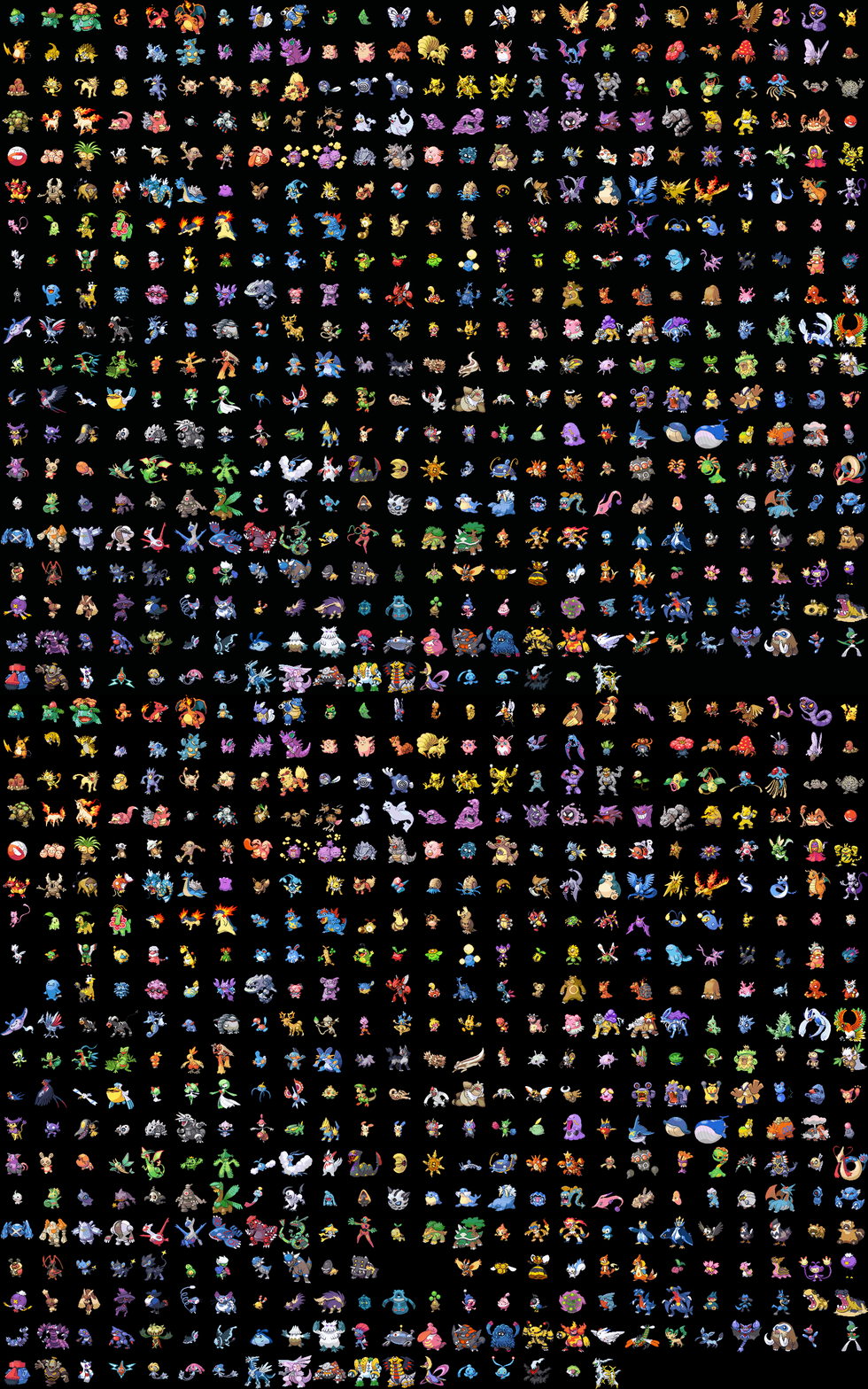
Probably the most obvious focus of the Pokémon franchise: it’s their tagline, after all. The idea of it is that a player should hypothetically be able capture every single currently-available Pokémon within the game.
Unfortunately, this has never really been true. Pokémon have always been locked behind different blockades: in earlier generations, Mythical Pokémon like Mew or Celebi were only available at live, in-person events, many of which were hosted in Japan and not widely-available in the United States. This left many players unable to acquire certain Pokémon species, and thus prevent them from actually fulfilling that primary objective. Not only does that practice come across as just unfair, but it also doesn’t make a whole lot of sense from a game design perspective: why severely limit players from actually being able to complete your game?
Unfortunately, Game Freak didn’t seem to quite figure that out and instead made things worse with their controversial decision to exclude over 500 Pokémon from the recent Sword and Shield games. They fixed this a bit by adding more Pokémon in to their DLC expansions, but that still leaves close to 200 Pokémon that are left out. That leaves almost 1/4 of the nearly 900 Pokémon unobtainable – and a lot of people are unhappy about it.

So how does this get fixed? Quite simply: make it so that every Pokémon species is obtainable in some way shape or form.
A few restrictions to put into place: first, there can still be version-exclusives. For those of you unfamiliar with the term, a version-exclusive is a Pokémon that is only available in one version of the game. For example, in Pokémon Sword, creatures like Deino, Kommo-o, and Farfetch’d can only be caught in that version of the game; in Pokémon Shield, creatures like Larvitar, Kabuto, and Zamazenta are exclusive to that version. This doesn’t really stop trainers from acquiring those Pokémon at all and encourages players from trading with those who have the opposite version of theirs: since this is such a key framework of the series (and arguably one of the reasons it got so popular), there really isn’t any reason to change it.
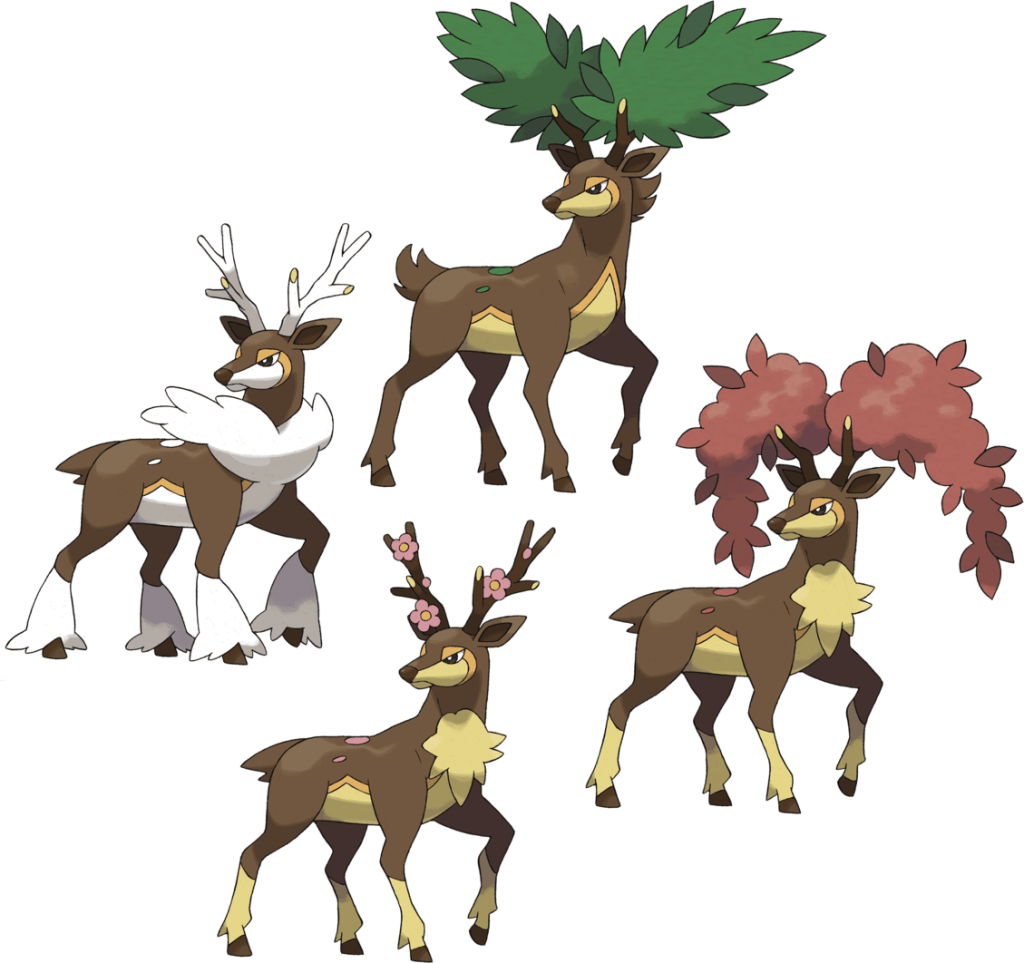
Some Pokémon already have weather or season-based variants.
Secondly, some Pokémon can still be hidden behind different seasons. Pokémon like Sawsbuck (pictured above), would appear in different forms based on the actual physical season – something the Black/White Pokémon games used already.
This is where Game Freak could hypothetically still have their events, by following in the footsteps of games like Animal Crossing and doing a kind of seasonal surprise. Spring has sprung? Celebi is out wandering in the world! Halloween draws near? Darkrai might be lurking in an exclusive dungeon.
This is actually something a companion game for the phone, Pokémon Go, does somewhat well. While there are certainly some lessons to be learned from PoGo’s missteps, seasonal event Pokémon that are only available for a limited time isn’t the worst idea in the world.
Now, I’m not saying that every Pokémon should be easy to obtain, and this brings me to another point: the need for a sense of accomplishment. Think about it: the Pokémon series tells you that you “gotta catch ’em all,” and so that should be the end goal, right? In addition to making it accomplishable, it should also be a rewarding challenge; you should feel like you actually had to work to get it done. Legendary and Mythical Pokémon, as well as Pokémon in their final stages of evolution, should absolutely be incredibly challenging to capture. This is something Pokémon Sword and Shield got wrong: in addition to cutting several hundred creatures, they also made it far too easy to catch all available Pokémon in the game. As of my writing this, there are already videos showing people catching all of the available creatures in the Crown Tundra DLC of Pokémon Sword and Shield within a few hours. I’ll talk more about why that’s a bad thing and how it can be fixed in Part 3 of this writing series, but just know that for now that sort of ease takes away all sense of accomplishment.
To wrap this first part up: if the Pokémon series is going to continue to tell players “gotta catch ’em all,” then future games must actually allow players to do just that. That doesn’t mean that every Pokémon has to be easy to catch, or that there can’t be some convoluted steps to acquire certain rare creatures. It does mean, however, that every Pokémon has to be obtainable in some way, shape, or form.
On the next episode of “Making a Modern Pokémon Game,” we’ll tackle another significant focus of the games: competition!
Credits
Kudos to some of the sources I read/watched while working on this (in no particular order).
- Reddit post discussing catching Legendaries by u/NetaKnight12
- Let’s Make a Pokemon Game! by JelloApocalypse
- What Pokémon Games Could and Should Be (But Sadly Aren’t) (Series Comparison and Retrospective) by jackdonsurfer
- Reddit post by u/Koolaidmoonwalk
 Jacob Ryckman