

Before We Begin
If you haven’t already, you’ll probably want to go ahead and read Part One of this blog series, starting here.
To summarize: it has become clear that the Pokémon has flatlined in terms of creativity. Sure, we get some new gimmick each generation like Mega Pokémon or Gigantamax, but that’s never enough to actually change the games or make them feel like they’ve properly evolved since their debut in the 1990s. So, like many others before me, I intend to put forth some ideas that will hopefully bring the Pokémon series into the modern era of gaming. The ideas here are meant to be plenty within the realm of possibility and still keep the core framework of the games – it’s not like I’m saying “we should add guns” or anything. Simply improving upon a franchise that’s been in need of it for at least a decade.
Last week, we discussed the idea of competition: specifically, the xp and Pokémon Gym systems. This week, we discuss something else that is a core staple of the Pokémon franchise:
Focus #3: Exploration
In my previous two posts, I proposed some ideas that weren’t necessarily revolutionary or mind-boggling a direction for the Pokémon franchise to go in, partly because they were ideas that Game Freak already acknowledges, ideas that have already been done in the Pokémon games before, or were simply obvious ideas that had been discussed and asked for by many, many people before.
Now, my big take here is not a new one. In fact, it’s been that has been proposed numerous times, especially in the last decade, and Pokémon Sword and Shield show that Game Freak may even be planning on moving the series in this direction. However, my hope is to flesh it out and provide suggestions of how to make it a positive experience for all, and how to vastly improve on some of Pokémon Sword and Shield’s missteps.
Turn Pokémon Into a Fully Open-World Game
Not exactly a hot take, right? Many people have suggested it. Pokémon Sword and Shield even have multiple Wild Areas, which are effectively open-world zones that players can explore and find various Pokémon in. However, the Wild Areas are…lackluster, to say the least, and did little to revolutionize the series as a whole. So what are the logical next-steps for Game Freak? How do they take a franchise that has been all about corridors and hand-holding, and allow players to have the freedom to make decisions for themselves? How do you build in that kind of trust?
Hopefully, this post will help to answer those questions (and more!). It’s going to be a bit long, so let’s get started!
The Starting Valley
Pokémon has always been known to hand-hold the players through some of the beginning of the game (or in some cases, literally the entirety of the game). This isn’t a terrible idea – after all, newer players often need a tutorial on what to do in a game so they understand the mechanics. But in order for a game to be truly ‘open-world’, that kind of hand-holding is going to need go away once players have gone through the ‘tutorial section’.
What I propose is something similar to Breath of the Wild’s Great Plateau: a starting area that showcases the basic mechanics the player will encounter – after players complete this area (which I am calling “The Starting Valley”), the reins are set loose and players aren’t forced to sit through tutorial after tutorial. This area should be small enough to not take up a significant portion of the map, but large enough to give players some sense of the freedom they’ll have once unleashed upon the world. There should also be some replayability, though I’ll get into that in another section.
Your journey begins like many others – you wake up one day when you are an adolescent, living in a small town. The local Pokémon Professor allows you to choose a Pokémon from a group of three, and you’re provided with a brief tutorial on catching and battling (though I suggest Game Freak give players the option to skip this tutorial if they want – we’ve been beaten to death with it). The Professor wants you to go out and complete the Pokédex for him – a lifelong goal of his that he became too old to fulfill.
There’s one problem, though: to leave the Starting Valley and properly fill out the Pokédex, you have to have a signed note from the Gym Leader in the nearby town. It’s a safety thing, since you’re so young. So if you can prove yourself capable of surviving the wilds and defeat the nearby Gym Leader, you’ll get your signed note and be allowed to explore the vast expanses of the world.
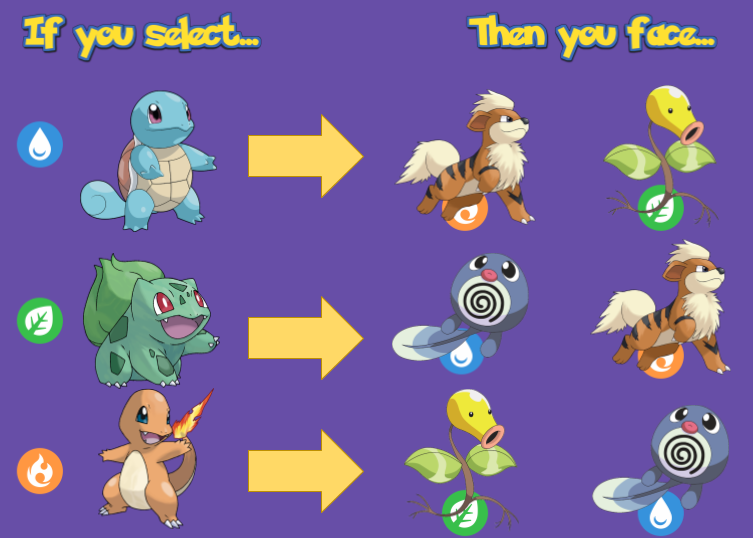
The first Gym Leader, like I mentioned before, should be the only one whose focus is on type advantages – they’ll give you the ropes on exactly how type advantages work, and their team will look something like the teams below:
Once you leave your humble town, you find yourself in an open world like the Wild Areas of Pokémon Sword and Shield – the valley is basically yours to explore all over. The valley previews some of the different types of Pokémon you might encounter and where you might encounter them – Pokémon like Rattata or Bellsprout roam the fields; a flock of Spearow aggressively defend a nesting area and attack in groups; a Magikarp can be seen splashing out of the water; in the edge close to the mountains, some Geodude conceal themselves to look like small boulders. You won’t find any evolved forms here, and some Pokémon might still be challenging to fight or acquire until you level up. But you have the freedom to see what’s out there and how to get it. You might even find a Trainer or two wandering around, itching for a battle.
After you defeat the first Gym Leader and acquire that precious signature, the rest of the world opens up to you. Suddenly, everything is yours to explore.
Environmental Puzzles/Skills
As awesome as it is to have the wide-open world available to you, there should still be a way to measure genuine player progress without Gym Badges or Pokédex completion. Not to mention, different areas of the world should have some replayability – as you progress on your journey, you gain new skills that allow you to go back to an area and do something you couldn’t before.
Previous games have had this, actually, through HMs (hidden machines) that taught your Pokémon moves that they didn’t normally have access to. These HMs were tied to Gyms, usually – once you defeated a certain gym, they would give you an HM and suddenly you could progress through the game. Pretty basic, but functional.
What I propose is this: rather than tying HMs to Gyms and Gym Leaders, tie them in with Pokédex completion, and make them scale up as you go along. For example, the first HM you get shouldn’t be that difficult to acquire – in fact, it can even be completed just within the Starting Valley. So let’s say…30 Pokédex entries. For 30 Pokédex entries, the Professor gives you HM01: Cut. Now you can slice through small trees or shrubbery that blocks different paths, but it also opens up opportunities to find Pokémon that might be hiding in those locations. A Pokémon like Sudowoodo might just ignore you entirely unless you try to use Cut on it – until you acquire that HM, Sudowoodo is completely unavailable to you.
By having HMs locked behind Pokédex progression, it encourages players to actually go out and try to capture all kinds of different Pokémon and evolve them, rather than sticking with whichever ones are competitively viable or meme-worthy and ignoring the rest.
Making Finding Pokémon Actually Fun
So I’ve mentioned that Pokémon Sword and Shield had their own kind of open-world-esque areas with the Wild Area, zones where Pokémon would wander and you could catch them freely. The beginning of a good concept, but one issue: it was extremely boring.
Part of this was just due to map design – the whole map was widely available, and while it was technically split up into some different zones, none of them felt all that different, especially with the random weather patterns. Oh, you’re going through what’s supposed to be a rocky desert-like zone? Well, it’s snowing there now so all you’ll find are Ice-type Pokémon. Pokémon also had this annoying tendency to just *pop* out of thin air right in front of you for no reason other than that the game had just decided to load them in. But honestly, this wasn’t why the Wild Area didn’t work.
It didn’t work because all of the Pokémon felt the same.
All of the Pokémon had the same behavior – wander around aimlessly, and if the player came by, they either tried to run from you or run at you. It was incredibly predictable, and none of the Pokémon felt truly unique in their own environment.
So what I propose really goes into two separate suggestions: make Pokémon far more regional within the world, and give different Pokémon unique behaviors that make them actually feel a part of the world they’re in.
Making Pokémon Regional
As I mentioned before, the Pokémon in Sword and Shield never truly felt like they belonged to the area they were in. Sure, some of the more evolved forms would only appear in certain spots, but everything else just boiled down to weather patterns. Nothing ever felt like it really belonged there. The Wild Area felt a lot less wild and a lot more static and pre-programmed.
How to fix this? Well, for starters, make it suuuuper clear that only certain Pokémon are going to appear in certain areas. Sure, some basic Pokémon like Pidgey or Starly can appear all over, but you shouldn’t be able to just happen across a Seismitoad because it’s raining.
Additionally, evolved forms should be incredibly rare, either locked behind different HM-accessible zones or appearing in exceptionally rare circumstances. This way they actually feel unique – you don’t normally see them, so they have an air of gravitas to them that an evolved form should. Sure, some evolved forms like Pidgeotto or Furret are going to appear more commonly because they aren’t overly powerful and resemble common animals, but Pokémon like Tyranitar? Rhyperior? Eeveelutions? If they show up at all, it should be so uncommon that you are actually surprised by their appearance.
This serves two reasons, the first which leads to the second. First, it forces it so that if players actually want the evolved forms of different Pokémon, they have to work at it – they can’t just wander the world for a while in the hopes of the right weather pattern or something. Secondly, because they have to work for the evolved forms, it will cause players to actually value them. Hey, that Gardevoir you spent time working on evolving? Actually has value to your team now! The Umbreon you had to work on building friendship with? You feel attached to it because you worked so hard to get that little Eevee to evolve!
Again, this was something Pokémon Sword and Shield was lacking in: actual emotion toward the creatures. And for a series that is always trying to preach to players about the importance of friendship and bonding with Pokémon, they sure haven’t done a great job of actually promoting that.
Giving Pokémon Unique Behaviors in the Wild
As I mentioned before, the Wild Area in Sword and Shield was boring because all of the Pokémon had the same predictable behavior: wander around until the player comes near. Their static nature took away some of the magic that wandering through the grass as a kid gave: in those games, you could almost imagine what the Pokémon were doing there, and additional media like the anime or manga helped flesh out that world further.
So to fix this, the solution is, well…maybe simple isn’t the right word: give Pokémon unique behaviors in which they are actually interacting with the world.
To this, I give a pre-existing example: Pokémon Snap. Pokémon Snap was a game where you would take photos of Pokémon in their natural environments. By today’s standards it’s nothing amazing, but at the time of the N64, it felt revolutionary. Suddenly Pokémon were actually interacting with the world, acting like living, breathing entities and not static images!
Today’s technology means that this is something absolutely achievable. I actually mentioned this earlier in this post, talking about how certain Pokémon might exhibit behaviors in the Starting Valley. A flock of Spearow defending a nest site, Magikarp leaping out of a pond, Pidgey flying overhead…there’s a lot of possibilities. Imagine wandering through a dark forested area and an Ariados leaps down from a giant web at you. Or you come across a series of holes in a desert, and suddenly you find yourself playing a version of Whack-A-Mole with a bunch of Diglett.
The idea is that it lends new personality to different Pokémon and makes them each special, rather than just bland counterparts doing the same thing over and over. And while we’re talking about making some Pokémon a little more unique to capture…
Legendary Pokémon and the Crown Tundra Blues
In the recent Crown Tundra DLC for Pokémon Sword and Shield, a ton of Legendary Pokémon suddenly became available. So many, in fact, that it’s suddenly become exceptionally easy to capture most of the Legendary Pokémon that have ever been released.
Some of these Legendaries actually have their own quests, like the Galarian Bird Trio, the Regis, and the Swords of Justice. These are actually decent, forcing you to track down different Pokémon and some even having small puzzles you have to solve in order to even gain access to them. But when all of them are simply within a small, tiny region, it feels overwhelmingly like Game Freak is just handing these once-special Pokémon out like candy. Where’s the challenge? The fun?
Legendary Pokémon should be, well, legendary. When you talk to townspeople in different cities, there should be rumors about them. Folktales or ghost stories about their appearance should inspire emotions: fear, wonder, excitement.
One way to do this is through in-game quests/events. Maybe after you’ve accumulated a few badges, you hear word that people are going missing in a town. You investigate, and late at night you’re captured by a mysterious Pokémon and brought into a hellish dimension: the Distortion World. After fighting your way through and rescuing several confused townsfolk, you finally find the source of the disappearances: an angry Giratina.
Perhaps you hear rumors of an abandoned science lab on an island. You Surf your way out to it and find the ruins. You wander your way through, fending off rogue Magneton and Meltan, having to search for different card keys that gain you access to the lower levels of the facility. Finally you arrive at a newer, more polished area, and suddenly you’re under assault by stronger, genetically-enhanced and uncatchable versions of other Pokémon. Mewtwo appears and challenges you to a battle against its team of suped-up starter evolutions, and then you fight against the abomination itself in an opportunity to catch it.
Maybe at the start of your Pokémon journey, you witness a Zapdos soaring overhead. As you wander the world, you hear rumors about it and other roaming Legendaries like Articuno and Moltres. When you get serious about finding them, you start following the rumors around, and they lead you to different locations around the world where they’ve nested. When you finally track one down, it attacks, forcing you to defeat it before having the opportunity to capture it.
See how much more storied and unique that sounds? Suddenly finding a Legendary goes from “oh just wander to this one place and it’ll be standing there doing nothing” to “wow that was actually a challenge that forced me to consider the Pokémon I brought along and how I handled myself.”
I’d say even pseudo-legendaries, or rare Pokémon, can get that treatment, too. There was a place in the Pokémon Silver, Gold, and Crystal games that always piqued my interest: the Ruins of Alph. When you went there, you were greeted with some tile puzzles. The puzzles themselves weren’t overly difficult, but when you solved them, you were dropped into a seemingly-empty cavern filled with Unown. The Unown felt creepy, otherworldly – you never quite understood why they were there or what to do with them. Unown aren’t even that powerful, but the mystery that surrounded them helped to turn an otherwise-useless Pokémon into something interesting and engaging.
In short, Legendary Pokémon (and even those that are less-legendary) should be an actual challenge to both discover and acquire. They don’t have to be a pain to capture – like we don’t need some annoying gauntlet of Dynamax battles – but they should be difficult. Capturing one should feel like an accomplishment, not a chore.
Smaller, Final Suggestions
- Bring back Dive. It doesn’t make sense that all of the Pokémon would just be swimming on the surface, and making Dive an HM gives it the opportunity to open up a huge chunk of the world. Imagine seeing a Gyarados racing towards you underwater, or a pod of Feebas swimming in formation.
- All Legendaries don’t have to be immediately available. Some can be locked behind seasonal events or specific weather-related things. But like I said in the post that started this all, they should all be available in some way.
- Actually have varied terrain. One of the biggest reasons the Wild Area felt so bland was because it was pretty flat. Rolling hills, towering mountains, sweeping valleys – these could all go a long way at making the world feel a bit more varied. Plus, different types of terrain could help in masking loading issues (possibly stopping the Pokémon pop-up annoyance)
- Some Pokémon maybe only start appearing after specific events. Maybe you do something that triggers the Legendary Dog trio to start roaming around, or an explosion at a factory causes Pokémon like Grimer or Garbodor to appear in a city.
If Game Freak is to actually turn Pokémon into an open-world game – a direction which it seems they want to go in – they will need to learn from the mistakes of Sword and Shield and look at good examples that already exist. Breathing life and wonder into the game will go a long way to breathing life back into a franchise that’s beginning to become a bit stale.
Anyways, that’s all I’ve got for the main blog post series! I hope you have thoroughly enjoyed these ideas – I know I had a lot of fun writing them. Thank you if you made it all this way!
Credits
Kudos to some of the sources I read/watched while working on this (in no particular order).
- Reddit post discussing catching Legendaries by u/NetaKnight12
- Let’s Make a Pokemon Game! by JelloApocalypse
- What Pokémon Games Could and Should Be (But Sadly Aren’t) (Series Comparison and Retrospective) by jackdonsurfer
- Reddit post by u/Koolaidmoonwalk
 Jacob Ryckman