

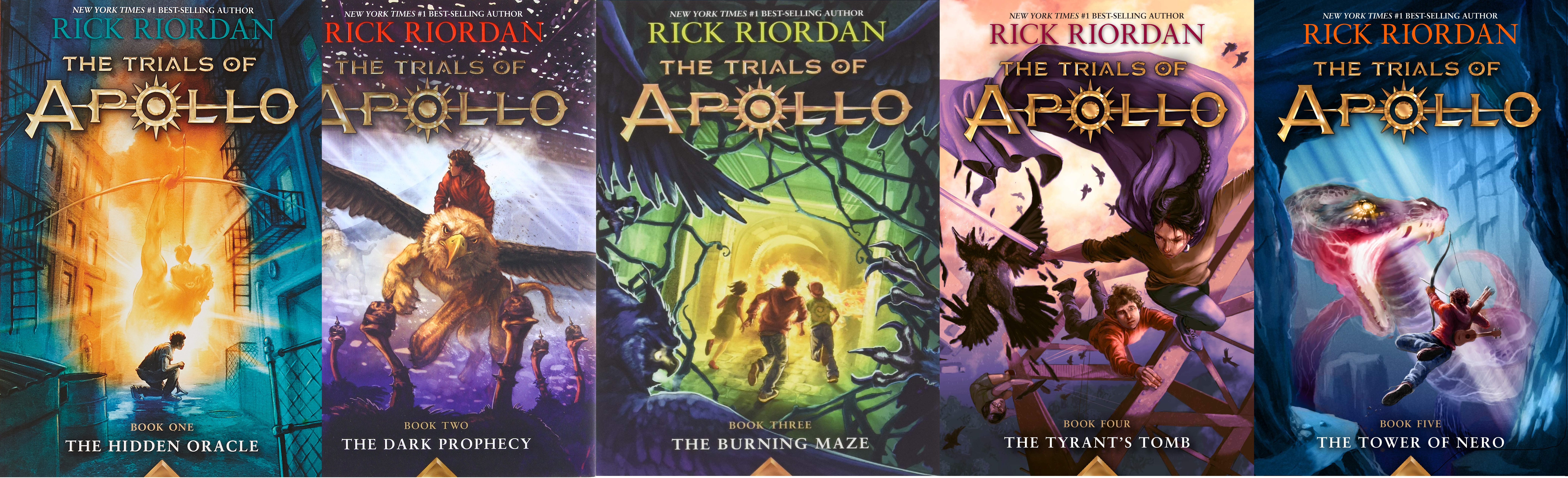
Brief (Spoiler-Free!) Synopsis
“The Trials of Apollo” series, by Rick Riordan, finds the ancient Greek god Apollo in mortal form, having been transformed by his father Zeus as punishment for a number of transgressions. Now in the less-than-ideal human form of Lester Papadopoulos, he must work to uncover a vicious plot by the mysterious Triumvirate Holdings.
The pentalogy is set in the same world as Riordan’s other series, with Trials of Apollo following just six months after the events of his “Heroes of Olympus” series.
Content Warnings: Death (Major Character Death), Child Abuse, Violence (PG-13)
What Do I Think?
From the first page, Apollo’s voice comes echoing out at you. It is beautifully written – at once, you believe that you are reading the words of a thousands-year-old god. Apollo is also funny – incredibly, incredibly funny. I daresay that this series is by far the funniest Rick Riordan has ever been, providing a constant stream of funny quips, dramatic irony, and engaging references to pop culture and history.
Over the course of the series, Apollo experiences exceptional growth, starting as an incredibly selfish man-child (a bit fitting then, that he is placed in the body of a teenager) and growing into someone who feels, well…godly. The story feels the need to point his out fairly often, but that growth can also be seen in so many smaller moments, highlighting again the strength of Riordan’s writing.
Another strength is Riordan’s ability to take ancient mythology (and history) and weave it into modern settings. The worldbuilding is just phenomenal, taking what he has already noted in previous installments and building upon it in ways that fit with previously-established material.
Unfortunately…
While the voice and worldbuilding are top-notch in this series, all five books feel incredibly padded. For a series that is marketed for children, these books are so very long, and while that has been a staple of his books since Percy Jackson, here it is dragged out and bloated. There are so many side-quests, so many mini-adventures, so many secondary plotlines, that at times it is as if Riordan let the story get away from him. I also got the sense that Riordan felt like he had to include most of the characters from his previous installments, but this often is to their detriment – characters who had undergone significant growth in previous novels find that progress diminished by some arbitrary plot that requires their participation.
Overall, however, this ends up being a minor gripe. At the end of the day, Trials of Apollo is still a phenomenal piece of fantasy fiction, and Riordan continues his trend of high-octane writing magic.
 Jacob Ryckman