
The school year is nearly here!
Well, in all honesty, it already is. Pre-service for most districts in my area has begun, and I know of campuses around the country that have already gone back to schooling, with many districts choosing remote learning. Teachers are working to establish their online setups, figuring out which tech platforms to use, and creating their expectations and rules for online learning.
Now, I want to focus on that last bit: classroom rules and expectations. We all have them. And with classroom environments shifting, teachers want to ensure that students understand what we expect from them in this new setting.
What concerns me is that some teachers are creating rules that don’t account for the difficulties students are facing right now.
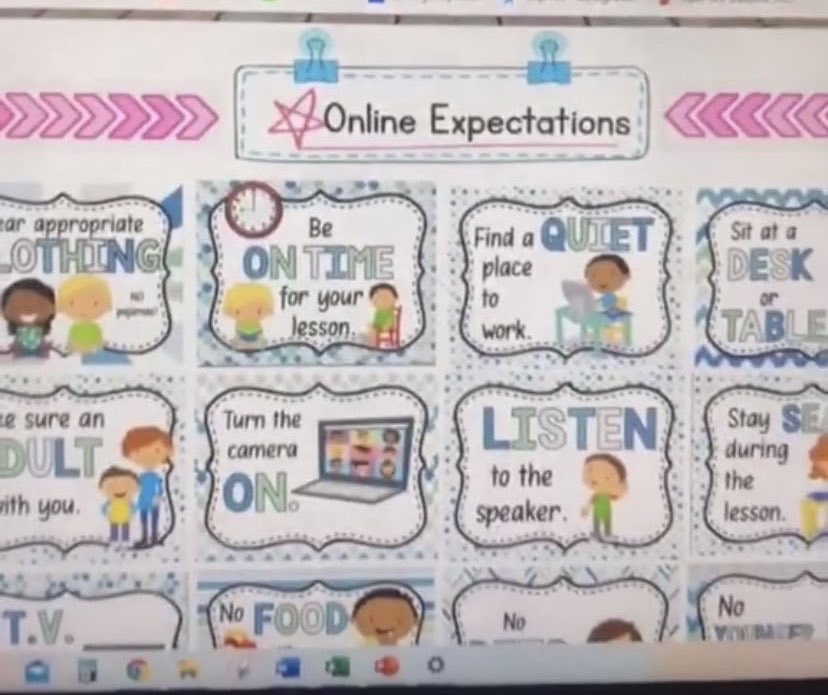
Take a look at the photo above – it’s a set of rules an elementary teacher created that I found on Twitter, and already much discussion and debate has been had over it. Why? Because it sets up expectations that are not realistic or feasible for every child.
What I’m going to do with this is focus on a few of the rules from this list, and then talk about how it can/should be changed so that it is more student-focused rather than teacher-focused: focusing on creating normalcy rather than on establishing dominance. Let’s begin!
Wear appropriate clothing (no pajamas!)
I’m going to be real with you: I don’t care if kids wear pajamas in my online classes. I teach high schoolers and my first class starts at 9am – pajamas are a-okay in my book.
With this rule, I think just leaving the “no pajamas” part is all you really need to do to fix it. Should kids still be wearing clothes? Absolutely! Should they be wearing clothes that are not indecent or just underwear? Yep! But do we really need to try and be the fashion-police in an online setting? Absolutely not. Next!
Sit at a desk or table
Let’s be real: not every kid has a desk or table in their room. Many students live in small, cramped apartments where space is limited. They might be sharing that space with siblings or a parent who has to work from home. As such, expecting kids to be working at a desk or table is simply unrealistic and doesn’t account for those who don’t have the ability to do so.
How to fix this? Personally, I’d change it to read “Try to sit somewhere comfortable.”
Think about it: when we are comfortable, we are able to get more work done. Heck, I’m writing this blog post on my phone whilst sitting on my couch!
Students are dealing with a lot of stress right now: parents may be out of work, they aren’t able to hang out with friends, and the threat of death by pandemic looms over them like a cackling grim reaper. Telling them that it’s okay to learn from their bed, or on their living room floor, or inside their closet, helps to alleviate at least a little bit of that stress. Give them a break.
Make sure an adult is with you
Do I really even need to address this one? Some parents are working, other are looking for jobs, and some families have multiple children who would need that attention. It’s not feasible, it’s not respectful of the parents, get rid of it.
Turn the camera on
So the main issue most people (including myself) have with this one is the fact that some students may be embarrassed to show their surroundings. They might not want their peers to see where they live, and there can be real issues of opening students up to ridicule because we force them to show that. There are so many ways to foster student interaction that don’t require a camera to be turned on.
Moreover…student privacy, yo. Next!
No food
You might be noticing a running theme with my corrections and nitpicks: student comfort. This “no food” rule has always been a bit of a stickler with me, and typically I allow students to snack in my classroom (provided it doesn’t become a distraction, of course).
Honestly, we don’t know what a student’s schedule might look like on any given day of remote learning. Like I mentioned earlier, my first period starts at 9am: some of my students might just be waking up then. I’d rather they be eating breakfast and trying to learn than be distracted because my punitive rule forced them to go hungry. Lord knows I will probably be snacking a little myself during this.
Final Thoughts
With everything going on, students have enough stress to deal with. Our expectations or rules should focus on helping them to feel less stressed – sure, we also want to make sure things are appropriate and that they’re learning, but we don’t need to become punitive or prissy about every little thing.
At the end of the day, grace is going to go a lot farther than harsh sentiments.
 Jacob Ryckman
[…] one was easy: I only had one blog post that I worked on during the week I considered for the word counts, and it was only 837 words. Even […]